
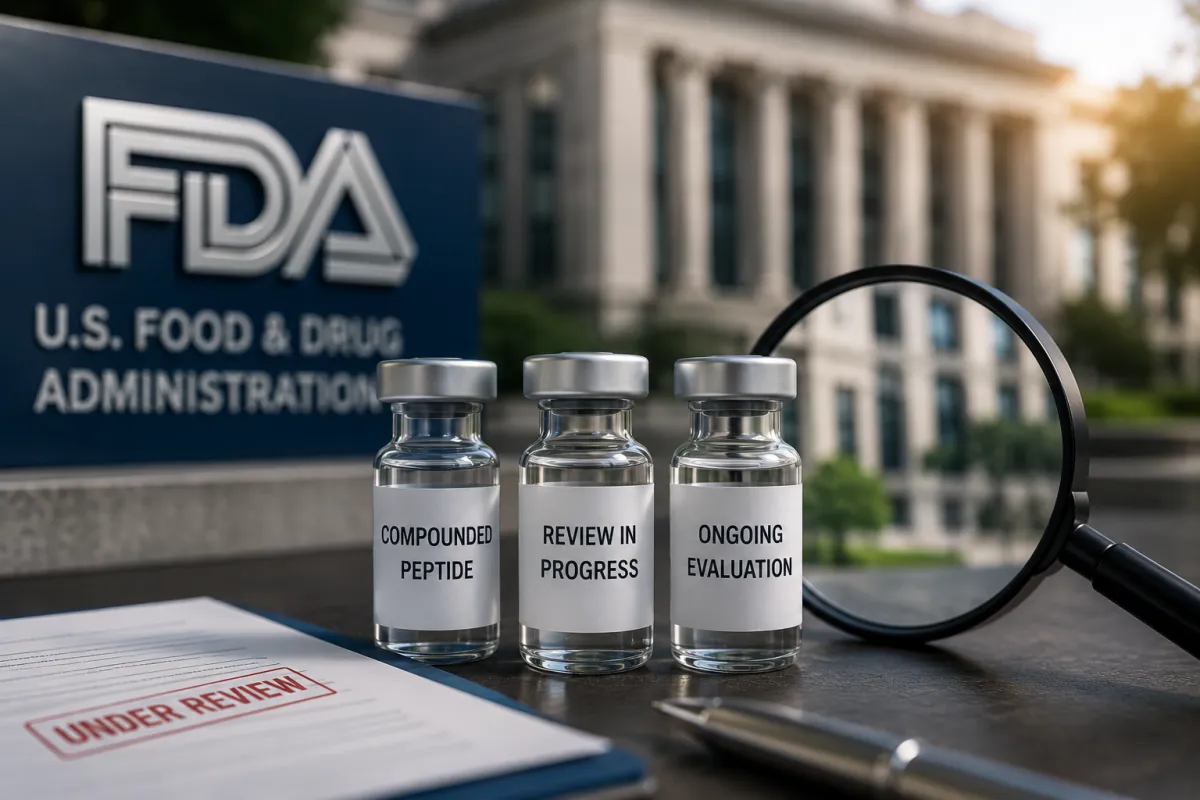
The FDA Is Reviewing Key Peptides For Compounding Ahead Of July 2026
The FDA Is Reviewing Key Peptides For Compounding Ahead Of July 2026, With Additional Peptides Including GHK-Cu, AOD-9604, CJC-1295, Ipamorelin, and LL-37 Expected To Be Discussed In Early 2027
On July 23–24, 2026, the FDA’s Pharmacy Compounding Advisory Committee is scheduled to review several peptide-related bulk drug substances being considered for inclusion on the 503A Bulks List.
The peptides listed for review include:
BPC-157
KPV
TB-500
MOTS-C
Emideltide, also referred to as DSIP
Semax
Epitalon
The key point for clinicians is this: these peptides are not being reviewed as FDA-approved medications. The committee is looking at whether these bulk drug substances should be considered for the 503A Bulks List, which is a separate process tied to traditional pharmacy compounding.
What The 503A Bulks List Means
Section 503A of the Federal Food, Drug, and Cosmetic Act applies to certain compounded medications prepared for an individually identified patient based on a valid prescription.
For a bulk drug substance to be used in traditional 503A compounding, it generally needs to meet one of the criteria outlined by FDA. One of those criteria is inclusion on the 503A Bulks List.
A bulk drug substance is the active pharmaceutical ingredient used to prepare a compounded medication. For peptides, this review process is focused on whether specific peptide-related bulk substances may be appropriate for potential use in 503A compounding.
The review is not the same as FDA drug approval. FDA approval evaluates a finished drug product for safety, efficacy, labeling, manufacturing, dosing, and specific clinical indications. The 503A Bulks List process is different. It evaluates whether a bulk substance may be used by certain compounding pharmacies under specific legal conditions.
Which Peptides Are Being Reviewed
According to the FDA meeting notice, the July 23, 2026 discussion will include:
BPC-157-related bulk drug substances
KPV-related bulk drug substances
TB-500-related bulk drug substances
MOTS-C-related bulk drug substances
The July 24, 2026 discussion will include:
Emideltide-related bulk drug substances, also referred to as DSIP
Semax-related bulk drug substances
Epitalon-related bulk drug substances
These peptides are often discussed in wellness, longevity, recovery, metabolic, neurocognitive, and regenerative medicine. This is exactly why the FDA review is worth watching. It gives these substances a more formal place in the compounding discussion, and clinicians need to understand what that does and does not mean.
In addition to the July 2026 review dates, clinicians should also be aware that FDA is expected to continue reviewing additional nominated peptide substances in future advisory committee meetings, including discussions anticipated around January or February 2027. Peptides expected to be part of those later review cycles include GHK-Cu, AOD-9604, CJC-1295, Ipamorelin, and LL-37, all of which have separately generated interest within regenerative medicine, metabolic health, recovery, and performance-focused clinical settings. As FDA scheduling evolves, clinicians should monitor official meeting notices to understand which peptides are formally included in each review cycle and how recommendations may differ between substances.
Why Clinicians Need To Understand The Review Process
Clinicians need to understand the FDA review process because it affects access, pharmacy sourcing, documentation, patient education, and how these peptides may be discussed in practice.
The review does not erase the science behind these peptides. It also does not define the entire value of peptide therapy. It simply determines how these substances are being evaluated within the current compounding system.
A peptide can have strong physiologic interest and still sit in a complicated regulatory category. That is not unusual in medicine, especially in areas where research, clinical use, and regulation are not moving at the same speed.
For healthcare professionals, the goal is not to wait for an agency to think for us. The goal is to understand the science, know the regulatory status, evaluate sourcing carefully, document clearly, and educate patients with accuracy.
That is what protects the patient, the clinician, and the integrity of this field.
What These Peptides Are Commonly Discussed For
Several of the peptides under review have gained attention because of research and clinical interest in tissue repair, inflammation, metabolic function, neurobiology, sleep regulation, and recovery. But these compounds did not appear overnight. DSIP was first isolated in the 1970s, thymosin beta-4 was sequenced in the early 1980s, BPC-157 has been studied for decades in gastric protection and wound-healing research, and MOTS-C was identified in 2015 as a mitochondrial-derived peptide involved in metabolic regulation. The public may be newer to these names, but the scientific interest behind many of them has been building for years.
BPC-157 is a gastric-derived pentadecapeptide, meaning it is made of 15 amino acids. The research around BPC-157 has focused heavily on tissue repair, blood vessel formation, nitric oxide signaling, tendon and ligament injury, wound healing, and gastrointestinal protection. One of the reasons it has gained so much interest is because it appears to influence several repair processes at once, including angiogenesis, collagen organization, endothelial function, and cellular migration.
KPV is a three-amino-acid peptide sequence from alpha-melanocyte-stimulating hormone, also known as alpha-MSH. Its clinical interest comes from how it interacts with inflammatory signaling. Research has shown KPV can reduce inflammatory signaling through NF-κB and MAP kinase activity, which are both involved in cytokine production and immune activation. This is why KPV is often connected to gut barrier function, immune balance, and inflammatory regulation.
TB-500 is a synthetic peptide fragment related to thymosin beta-4. Thymosin beta-4 is naturally present in many tissues and plays an important role in actin regulation. Actin helps cells move, organize, and respond to injury. This is why thymosin beta-4 research is tied to wound repair, tissue remodeling, angiogenesis, and cell migration. Clinically, the key point is not just “healing.” The deeper point is how cellular movement and tissue organization influence repair.
MOTS-C is a mitochondrial-derived peptide encoded within mitochondrial DNA. It is a 16-amino-acid peptide connected to metabolic regulation, insulin sensitivity, skeletal muscle signaling, and energy balance. Research shows MOTS-C can activate AMPK-related signaling, which is one of the body’s major energy-sensing systems. This is why MOTS-C is so important in conversations around metabolic dysfunction, obesity-related physiology, mitochondrial health, and insulin resistance.
Semax is a synthetic peptide derived from the ACTH 4-10 fragment. It was designed to preserve neuroactive effects without producing the same adrenal-stimulating activity associated with ACTH. Semax research has focused on neuroprotection, cognitive function, stress response, and brain-derived neurotrophic factor, also known as BDNF. BDNF is important because it supports neuronal survival, plasticity, and brain adaptation.
Epitalon is a synthetic tetrapeptide made of four amino acids: Ala-Glu-Asp-Gly. It is modeled after pineal peptide research and is most often connected to circadian biology, melatonin regulation, telomerase activity, and cellular aging research. The reason Epitalon gets so much attention is because it sits at the intersection of sleep, aging biology, oxidative stress, and cellular repair signaling.
Emideltide, also referred to as DSIP, stands for delta sleep-inducing peptide. DSIP is a nonapeptide, meaning it contains nine amino acids. It was originally identified in sleep research and has been studied for its relationship to delta-wave sleep, stress regulation, neuroendocrine function, and nervous system recovery. From a clinical education standpoint, DSIP is not just a “sleep peptide.” It belongs in a broader discussion about how sleep, stress physiology, and repair biology are connected.
Why Sourcing And Labeling Matter
A “research use only” label does not automatically mean a peptide itself lacks value. It means the product is not being provided as a patient-specific compounded medication through a licensed pharmacy process.
The concern is not that peptide science is bad. The concern is whether the product a patient receives has been prepared, tested, stored, labeled, and dispensed through a channel built for human clinical use.
For clinicians, sourcing is part of patient safety. When a peptide comes from a qualified compounding pharmacy, there is a different level of oversight around:
pharmacy licensure
prescription requirements
sterility practices
concentration accuracy
storage conditions
lot tracking
beyond-use dating
patient-specific dispensing
documentation
and adverse event reporting
That is why the compounding discussion is so important. The goal is not to dismiss these peptides. The goal is to help clinicians understand how access, quality, and responsible patient care connect.
What Clinicians Should Understand Before Interpreting The Review
The FDA review is not simply about whether a peptide “works” or does not work. The larger issue is how these substances fit into compounding, sourcing, patient care, and responsible clinical use.
A peptide can have decades of mechanistic research, published literature, physiologic rationale, and growing clinical interest while still existing in a complicated regulatory environment. Those things are not mutually exclusive.
For clinicians, the goal should be understanding the full picture around the peptide itself:
what the peptide is derived from
what receptor, pathway, or signaling system it influences
what physiologic role it may play
whether the data is mechanistic, animal-based, observational, or human clinical data
what limitations exist within the research
what conditions or medications may require caution
what the peptide is realistically being used for clinically
and whether the sourcing process meets appropriate compounding and pharmacy standards
This is where peptide therapy becomes much deeper than memorizing protocols or hearing claims online.
Take BPC-157 as an example. Understanding BPC-157 requires understanding angiogenesis, nitric oxide signaling, fibroblast activity, tendon physiology, gastrointestinal protection, and tissue repair biology. Understanding MOTS-C requires understanding mitochondrial signaling, insulin sensitivity, skeletal muscle metabolism, and AMPK activation. Understanding Semax requires understanding neurobiology, BDNF signaling, stress physiology, and neuronal plasticity. That level of understanding changes how clinicians evaluate peptides altogether.
The FDA review process is only one piece of the discussion. Clinicians still need to understand the physiology, the mechanisms, the evidence, the patient selection process, and the clinical reasoning behind why these peptides are attracting so much attention in medicine right now.
Why This Creates A Major Education Gap
Most healthcare professionals were never formally taught peptide pharmacology, compounding access, nominated bulk drug substances, research-use labeling, or pharmacy sourcing during traditional training.
That leaves clinicians trying to understand the peptide’s mechanism, the quality of the available research, the regulatory category, the pharmacy source, the patient’s goals, and the documentation needed to support responsible care.
A clinician may understand inflammation, tissue repair, mitochondrial dysfunction, or neurobiology, but still feel unsure how those concepts apply to a specific peptide, patient, or pharmacy source. That gap comes from lack of structured education in a field that was never taught clearly.
Clinicians need to understand the difference between:
FDA-approved medications
compounded medications
investigational compounds
nominated bulk drug substances
research-use products
and products being marketed outside appropriate clinical channels
Each category affects sourcing, documentation, patient education, informed consent, pharmacy selection, and scope of practice differently. Without that foundation, peptide therapy becomes easy to misunderstand, oversimplify, or avoid altogether.
What Clinicians Should Watch Before July 2026
Before the July 2026 meeting, clinicians should watch for updates from FDA, the Federal Register, pharmacy boards, compounding pharmacies, and professional organizations.
The main questions to follow are:
Which peptides are being reviewed?
What uses are being discussed?
What safety concerns are raised?
What evidence is presented?
What does the advisory committee recommend?
Does FDA take further action after the meeting?
How do state pharmacy boards respond?
How do 503A pharmacies interpret the outcome?
The advisory committee can make recommendations, but FDA action and practical pharmacy access may involve additional steps.
Conclusion
The July 2026 FDA review brings BPC-157, KPV, TB-500, MOTS-C, Emideltide/DSIP, Semax, and Epitalon into a formal discussion around 503A compounding consideration. For clinicians, this is an important moment because it shows how much peptide therapy is continuing to grow, evolve, and enter more serious clinical and regulatory discussions.
This is not a time for fear. It is a time for better education.
Clinicians need to understand the peptides themselves, the mechanisms behind them, the regulatory categories, the sourcing considerations, and the clinical reasoning required to discuss them responsibly with patients. That kind of education helps move peptide therapy forward with more clarity, more professionalism, and more respect for the science behind this field.
This is exactly why I created Peptide Therapy in Clinical Practice. The program was built to help licensed healthcare professionals understand peptide therapy beyond surface-level protocols, so they can think through physiology, safety, patient education, documentation, and responsible integration with confidence.
Peptide therapy is one of the most exciting areas in modern medicine right now. The clinicians who choose to understand it deeply will be the ones helping shape where this field goes next.
About The Author
Lauren Supra, RN, BC-FMP is the founder of Advera Care and creator of Peptide Therapy in Clinical Practice, an accredited continuing medical education program designed to help licensed healthcare professionals better understand peptide therapy, physiology, regulatory considerations, and responsible clinical integration.
References
U.S. Food and Drug Administration. (2026). July 23–24, 2026 meeting of the Pharmacy Compounding Advisory Committee. https://www.fda.gov/advisory-committees/advisory-committee-calendar/july-23-24-2026-meeting-pharmacy-compounding-advisory-committee-07232026
U.S. Food and Drug Administration. (2025). Bulk drug substances nominated for use in compounding under section 503A of the Federal Food, Drug, and Cosmetic Act. https://www.fda.gov/drugs/human-drug-compounding/bulk-drug-substances-nominated-use-compounding-under-section-503a-federal-food-drug-and
U.S. Food and Drug Administration. (2024). Compounding and the FDA: Questions and answers. https://www.fda.gov/drugs/human-drug-compounding/compounding-and-fda-questions-and-answers
U.S. Food and Drug Administration. (2024). Human drug compounding. https://www.fda.gov/drugs/guidance-compliance-regulatory-information/human-drug-compounding
Federal Register. (2026). Pharmacy Compounding Advisory Committee; notice of meeting; establishment of a public docket; request for comments. https://www.federalregister.gov/documents/2026/04/16/2026-07361/pharmacy-compounding-advisory-committee-notice-of-meeting-establishment-of-a-public-docket-request
Sikiric, P., Seiwerth, S., Rucman, R., Kolenc, D., Vuletic, L. B., Drmic, D., Grgic, T., Strbe, S., Zoricic, I., & Kokot, A. (2018). Stable gastric pentadecapeptide BPC 157 and wound healing. Current Pharmaceutical Design, 24(18), 1998–2010. https://doi.org/10.2174/1381612824666180424144851
Luger, T. A., Scholzen, T. E., Brzoska, T., & Böhm, M. (2007). α-MSH related peptides: A new class of anti-inflammatory and immunomodulating drugs. Annals of the Rheumatic Diseases, 66(Suppl 3), iii52–iii55. https://pmc.ncbi.nlm.nih.gov/articles/PMC2095288/
Huff, T., Müller, C. S. G., Otto, A. M., Netzker, R., & Hannappel, E. (2001). β-Thymosins, small acidic peptides with multiple functions. The International Journal of Biochemistry & Cell Biology, 33(3), 205–220. https://doi.org/10.1016/S1357-2725(00)00087-X
Lee, C., Zeng, J., Drew, B. G., Sallam, T., Martin-Montalvo, A., Wan, J., Kim, S.-J., Mehta, H., Hevener, A. L., de Cabo, R., Cohen, P., & Kim, K. H. (2015). The mitochondrial-derived peptide MOTS-c promotes metabolic homeostasis and reduces obesity and insulin resistance. Cell Metabolism, 21(3), 443–454. https://doi.org/10.1016/j.cmet.2015.02.009
Dolotov, O. V., Inozemtseva, L. S., Myasoedov, N. F., & Grivennikov, I. A. (2006). Semax, an analog of ACTH(4–10) with cognitive effects, regulates BDNF and trkB expression in the rat hippocampus. Brain Research, 1117(1), 54–60. https://doi.org/10.1016/j.brainres.2006.08.001
Strekalova, T., & Steinbusch, H. W. M. (2010). Measuring behavior in mice with chronic stress depression paradigm. Progress in Neuro-Psychopharmacology and Biological Psychiatry, 34(2), 348–361. https://doi.org/10.1016/j.pnpbp.2009.11.014
Schneider-Helmert, D. (2001). Delta sleep-inducing peptide. European Journal of Anaesthesiology, 18(7), 421–424. https://journals.lww.com/ejanaesthesiology/fulltext/2001/07000/delta_sleep_inducing_peptide.1.aspx