
What Clinicians Need To Understand About Obesity, Metabolism, And Modern Weight Loss Medicine
What Clinicians Need To Understand About Obesity, Metabolism, And Modern Weight Loss Medicine
For decades, obesity was largely viewed as a problem of personal responsibility. Patients were told to eat less, exercise more, and lose weight. When that approach failed, the assumption was often that the patient simply lacked discipline, motivation, or adherence.
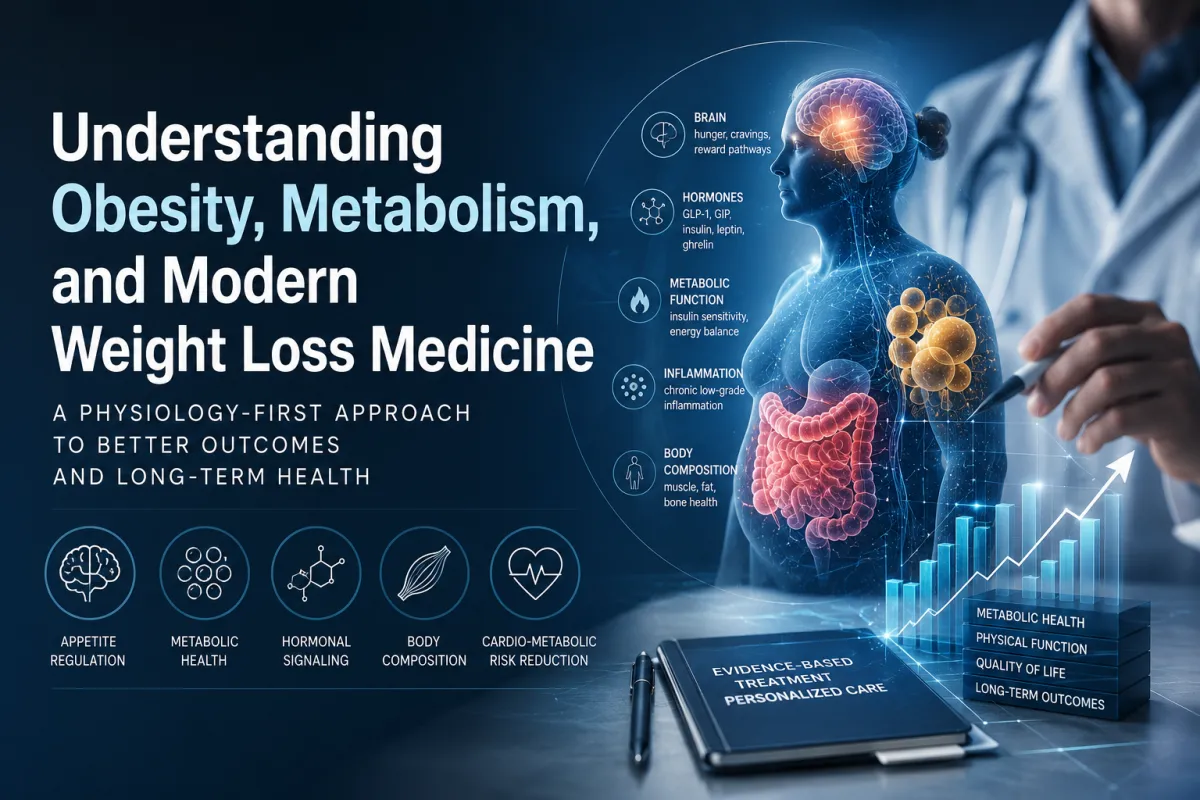
Today, we understand that obesity is far more complex than calories, willpower, or body weight alone. Obesity is increasingly recognized as a chronic metabolic disease involving appetite regulation, insulin signaling, inflammation, energy balance, neurobiology, body composition, and multiple hormonal systems that influence how the body stores and utilizes energy. This shift in understanding has changed obesity medicine. It has also exposed how much there still is to learn.
Obesity Is Not Simply A Weight Problem
One of the biggest misconceptions in healthcare is that obesity is primarily a body weight problem. Body weight is often the most visible sign, but it is rarely the entire story. Many patients begin experiencing metabolic dysfunction years before significant weight gain occurs. Hunger signaling may change. Satiety signaling may become impaired. Insulin resistance starts developing. Inflammation increases. Energy regulation may become less efficient.
By the time substantial weight gain occurs, physiologic changes have often been developing for years.
Many patients report symptoms such as:
* constant hunger
* food cravings
* fatigue
* poor recovery
* difficulty losing weight
* increasing abdominal fat
* declining energy levels
* worsening blood sugar control
Weight gain often receives attention. The underlying metabolic dysfunction is frequently what deserves investigation.
The Brain Plays A Larger Role Than Many Realize
Obesity is often discussed as though it exists primarily within adipose tissue. In reality, the brain plays a major role in appetite regulation, food-seeking behavior, reward signaling, satiety, and energy balance.
The gastrointestinal tract, adipose tissue, pancreas, liver, and brain are constantly exchanging signals that help determine when we eat, how much we eat, how satisfied we feel after eating, and how the body responds to nutrient availability.
When these signaling systems become dysregulated, patients may experience persistent hunger, increased cravings, reduced satiety, and difficulty maintaining weight loss even when they are making substantial efforts to improve their health.
This is one reason the term “food noise” has become increasingly recognized in obesity medicine. Many patients describe constant thoughts about food, persistent cravings, and a mental burden surrounding eating decisions that can feel impossible to overcome through willpower alone.
For years, these experiences were often dismissed as poor self-control. Modern obesity medicine has helped reveal that many of these struggles are deeply rooted in physiology.
Insulin Resistance Changes The Entire Metabolic Picture
Insulin resistance remains one of the most misunderstood components of metabolic disease. Insulin helps move glucose from the bloodstream into cells where it can be used for energy. When cells become less responsive to insulin, the body often compensates by producing more. Over time, elevated insulin levels may contribute to increased fat storage, worsening metabolic flexibility, elevated triglycerides, blood sugar dysregulation, and difficulty losing weight.
Insulin resistance does not explain every case of obesity, and obesity does not occur solely because of insulin resistance. However, the relationship between metabolic dysfunction and body weight regulation is much stronger than many people realize. When clinicians focus exclusively on calories while ignoring insulin signaling, they often miss a significant part of the clinical picture.
Why Obesity Is A Metabolic Disease, Not Just A Weight Problem
One of the biggest mistakes in obesity medicine is viewing adipose tissue as nothing more than a storage site for excess calories. Adipose tissue is metabolically active and constantly communicates with other systems throughout the body. As adipose tissue expands, changes can occur in inflammatory signaling, insulin sensitivity, hormone regulation, vascular function, and overall metabolic health. These changes help explain why obesity is associated with a much higher risk of chronic diseases that extend far beyond body weight alone.
Research has linked obesity to conditions such as type 2 diabetes, cardiovascular disease, metabolic dysfunction-associated steatotic liver disease (MASLD), sleep apnea, osteoarthritis, and several forms of cancer. This is one reason obesity medicine has shifted away from focusing solely on weight loss and toward improving metabolic health, reducing disease risk, and restoring physiologic function.
When clinicians understand obesity as a chronic metabolic disease rather than simply a weight problem, the focus expands beyond calories and begins to include insulin resistance, inflammation, appetite regulation, energy balance, body composition, and the biologic systems influencing long-term health outcomes.
GLP-1 Medications Changed The Conversation
Few developments have changed obesity medicine more than GLP-1 receptor agonists.
For years, many clinicians watched patients repeatedly lose weight, regain weight, and struggle with hunger despite following nutrition and exercise plans. The common assumption was that patients simply needed more discipline. Then peptides such as Semaglutide and Tirzepatide began producing results that forced medicine to look deeper at the biology driving obesity.
One of the most interesting observations was not simply the weight loss itself. It was the change in appetite regulation. Many patients described something they had never experienced before. They reported fewer cravings, less preoccupation with food, reduced hunger, and a sense of mental quiet surrounding eating decisions. This experience became widely known as a reduction in “food noise.”
For clinicians, this was an important lesson. It highlighted that hunger, cravings, and eating behavior are not driven solely by willpower. They are influenced by signaling systems involving the brain, gastrointestinal tract, hormones, neurotransmitters, and metabolic health. GLP-1 peptides helped expose how powerful those signaling systems can be.
Weight Loss And Metabolic Health Are Not Always The Same Thing
The success of GLP-1 medications has also created an important clinical challenge. Many patients are losing weight. Not all of them are becoming healthier. A patient can lose significant weight while simultaneously losing muscle mass, under-consuming protein, developing nutrient deficiencies, and reducing physical function. The scale may move in the right direction while other important health markers move in the wrong direction.
This is one reason body composition deserves more attention than body weight alone. Two patients may each lose 40 pounds. One may lose primarily body fat while preserving muscle mass, strength, and metabolic function. The other may lose both fat and lean tissue, leading to weakness, poor recovery, and reduced physical performance. The scale cannot distinguish between those outcomes. Clinicians need to.
Muscle Is One Of The Most Important Metabolic Organs In The Body
Skeletal muscle does much more than create strength and movement. Muscle plays a major role in glucose disposal, insulin sensitivity, energy production, physical function, metabolic flexibility, and healthy aging. As muscle mass declines, patients may experience reduced metabolic health, worsening insulin sensitivity, decreased strength, impaired recovery, and increased risk of frailty as they age. This becomes particularly important during weight loss.
When appetite decreases significantly, some patients unintentionally reduce protein intake, stop resistance training, or consume far fewer nutrients than their body requires. Under those circumstances, muscle loss can occur alongside fat loss. The goal should never be weight loss at any cost. The goal should be improved metabolic health while preserving the tissues that help support long-term function and resilience.
Retatrutide May Push Obesity Medicine Even Further
Retatrutide is one of the most closely watched investigational therapies in obesity medicine today. Unlike Semaglutide, which primarily targets GLP-1, or Tirzepatide, which targets both GLP-1 and GIP, Retatrutide targets three receptors:
GLP-1
GIP
Glucagon
This triple agonist approach has generated significant interest because it expands the discussion beyond appetite suppression alone. Researchers are now examining how multiple signaling systems influence energy expenditure, fuel utilization, body composition, metabolic regulation, and long-term health outcomes. The significance extends beyond the amount of weight loss observed in clinical trials.
Retatrutide reflects a larger shift occurring throughout obesity medicine. Researchers are increasingly moving away from simplistic explanations centered solely on calories and body weight and toward a deeper understanding of the signaling systems that regulate human metabolism.
The Future Of Obesity Medicine Is Physiology
Obesity medicine is changing rapidly. The conversation is no longer limited to calories consumed versus calories burned. Clinicians are increasingly examining insulin resistance, appetite regulation, satiety signaling, inflammation, mitochondrial function, body composition, neurobiology, and energy balance. That evolution is creating better questions.
Instead of asking why a patient cannot lose weight, clinicians are beginning to ask what physiologic barriers may be preventing success. Instead of focusing exclusively on the scale, more attention is being placed on metabolic health, physical function, body composition, and disease risk reduction. This is where modern obesity medicine becomes far more effective.
Why Education Matters
Healthcare professionals are caring for patients during one of the most significant shifts obesity medicine has experienced in decades.
Understanding obesity today requires much more than memorizing medication names or treatment algorithms. Clinicians need a deeper understanding of metabolism, endocrinology, insulin signaling, inflammation, body composition, appetite regulation, and the physiologic systems influencing health outcomes.
Without that foundation, it becomes difficult to fully understand why patients struggle, why therapies succeed or fail, and how to develop individualized treatment strategies that extend beyond weight loss alone.
Conclusion
Obesity is not simply a condition of excess body weight. It is a complex chronic disease involving signaling systems that regulate hunger, satiety, metabolism, inflammation, energy expenditure, body composition, and overall physiologic function.
As research continues to evolve, clinicians are being challenged to move beyond outdated explanations and develop a deeper understanding of the biology driving obesity and metabolic disease. The goal is not simply to help patients lose weight. The goal is to improve metabolic health, preserve function, reduce disease risk, and create better long-term outcomes.
That is exactly why I created Peptide Therapy in Clinical Practice.
The program was designed to help healthcare professionals better understand peptide therapy, metabolic physiology, obesity medicine, and clinical decision-making through a deeper understanding of the signaling systems that influence human health every day.
References
Aronne, L. J., Hall, K. D., Apovian, C. M., et al. (2021). Describing the weight-reduced state: Physiology, behavior, and interventions. Obesity, 29(S1), S9–S24. https://doi.org/10.1002/oby.23087
Drucker, D. J. (2022). GLP-1 physiology informs the pharmacotherapy of obesity. Molecular Metabolism, 57, 101351. https://doi.org/10.1016/j.molmet.2021.101351
Jastreboff, A. M., Kaplan, L. M., Frías, J. P., et al. (2023). Triple-hormone-receptor agonist retatrutide for obesity—A phase 2 trial. The New England Journal of Medicine, 389(6), 514–526. https://doi.org/10.1056/NEJMoa2301972
Müller, T. D., Blüher, M., Tschöp, M. H., & DiMarchi, R. D. (2022). Anti-obesity drug discovery: Advances and challenges. Nature Reviews Drug Discovery, 21(3), 201–223. https://doi.org/10.1038/s41573-021-00337-8
Wharton, S., Lau, D. C. W., Vallis, M., et al. (2020). Obesity in adults: A clinical practice guideline. Canadian Medical Association Journal, 192(31), E875–E891. https://doi.org/10.1503/cmaj.191707