
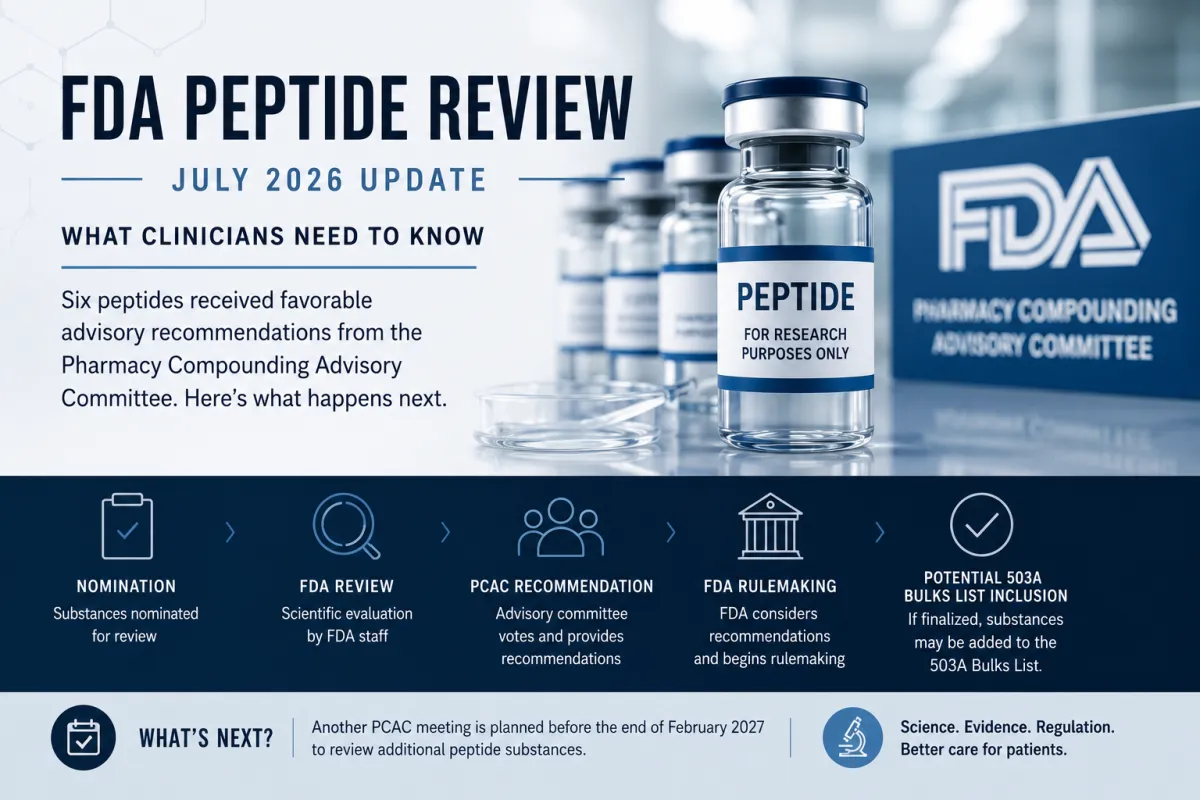
Six Peptides Received Favorable Advisory Recommendations: What Every Clinician Needs To Know After The FDA’s July 2026 Review
Six Peptides Received Favorable Advisory Recommendations: What Every Clinician Needs To Know After The FDA’s July 2026 Review
One of the most significant regulatory events in peptide medicine took place on July 23 and 24, 2026, when the FDA’s Pharmacy Compounding Advisory Committee (PCAC) met to review seven peptide nominations for potential inclusion on the Section 503A Bulks List. For healthcare professionals who follow peptide therapy, this meeting represented much more than a routine regulatory discussion. It marked the first time several widely discussed peptides were formally evaluated together through the FDA’s advisory process.
By the conclusion of the meeting, the advisory committee voted in favor of recommending six of the seven peptides for potential inclusion on the 503A Bulks List. The committee recommended BPC-157, KPV, TB-500, MOTS-C, Semax, and Epitalon. Emideltide, also known as delta sleep-inducing peptide (DSIP), was the only peptide that did not receive a favorable recommendation.
Those results generated headlines across the peptide community. Unfortunately, many of those headlines also created confusion. Some suggested these peptides had been “approved.” Others implied they would immediately become available through compounding pharmacies. Neither interpretation is accurate.
To understand why this meeting matters, clinicians first need to understand what the committee was actually evaluating.
What Was The FDA Reviewing?
The Pharmacy Compounding Advisory Committee was not determining whether these peptides are FDA-approved medications. It was not deciding whether clinicians should prescribe them, and it was not determining whether the underlying physiology of these peptides is valid.
Instead, the committee was asked to evaluate whether specific bulk drug substances should be recommended for potential inclusion on the Section 503A Bulks List. If ultimately accepted by the FDA after additional review, that decision could allow qualifying 503A compounding pharmacies to compound these bulk substances under the conditions established by federal law.
This distinction is important because FDA approval, clinical evidence, prescribing decisions, and compounding regulations are separate regulatory questions. Confusing one with another has contributed to much of the misunderstanding surrounding peptide therapy over the past several years.
The Seven Peptides Reviewed And Why They Were Nominated
One of the biggest misconceptions surrounding the July 2026 Pharmacy Compounding Advisory Committee meeting was that the FDA was broadly evaluating whether these peptides “work.” That was not the purpose of the meeting.
Instead, each peptide was reviewed for one or more specific nominated clinical uses submitted as part of the Section 503A Bulks List process. Those nominated uses provided the framework for the committee’s discussion and allowed members to evaluate the available evidence for each bulk drug substance within a defined clinical context.
Although these peptides are frequently discussed across regenerative medicine, obesity medicine, neurology, and longevity, the committee’s review remained focused on the specific conditions for which each substance had been nominated rather than every potential physiologic effect that has been explored in the scientific literature.
BPC-157
BPC-157 was reviewed for ulcerative colitis, a chronic inflammatory bowel disease characterized by persistent inflammation and ulceration of the colon.
BPC-157 is a synthetic pentadecapeptide derived from a protective protein naturally found in gastric juice. Over the past two decades, it has generated considerable scientific interest because of research examining its effects on angiogenesis, nitric oxide signaling, tissue repair, gastrointestinal integrity, tendon healing, and cellular migration. Although clinicians often associate BPC-157 with musculoskeletal injuries, its nomination for the July meeting centered specifically on ulcerative colitis rather than orthopedic applications.
KPV
KPV was reviewed for wound healing and inflammatory conditions.
KPV is a naturally occurring three-amino-acid fragment of alpha-melanocyte-stimulating hormone (α-MSH). Research has demonstrated that this small peptide can influence inflammatory signaling by modulating pathways involved in cytokine production and immune regulation. Because of these properties, KPV has attracted interest in gastrointestinal disorders, dermatologic inflammation, and conditions involving impaired epithelial barrier function.
TB-500
TB-500 was reviewed for wound healing.
TB-500 is a synthetic fragment based on thymosin beta-4, a naturally occurring protein involved in tissue repair. Rather than simply reducing inflammation, thymosin beta-4 plays an important role in actin regulation, cellular migration, angiogenesis, and tissue remodeling. These mechanisms have made TB-500 one of the most widely discussed peptides in regenerative medicine and sports medicine research.
MOTS-C
MOTS-C was reviewed for obesity and osteoporosis.
Unlike many peptides produced by endocrine glands, MOTS-C is encoded within mitochondrial DNA. It has become an important area of metabolic research because of its potential influence on glucose metabolism, insulin sensitivity, exercise physiology, mitochondrial function, and energy homeostasis. As obesity medicine continues to evolve beyond calorie restriction alone, mitochondrial signaling has become an increasingly important area of investigation.
Semax
Semax was reviewed for cerebral ischemia, migraine, and trigeminal neuralgia.
Semax is a synthetic peptide originally developed from a fragment of adrenocorticotropic hormone (ACTH). Unlike ACTH itself, Semax does not stimulate adrenal corticosteroid production. Instead, research has focused on its effects involving neuroplasticity, brain-derived neurotrophic factor (BDNF), cognition, and neurologic recovery. It has been used clinically in parts of Eastern Europe for several neurologic conditions, making it one of the more extensively discussed neuropeptides considered during the meeting.
Epitalon
Epitalon was reviewed for insomnia.
Epitalon is a synthetic tetrapeptide based on epithalamin, a peptide complex associated with the pineal gland. Although many clinicians recognize Epitalon for its association with aging biology and telomere research, the committee’s review focused specifically on its proposed use for insomnia. Research surrounding Epitalon has also explored circadian rhythm regulation, melatonin secretion, and healthy aging, making it one of the more unique peptides discussed during the meeting.
Emideltide (DSIP)
Emideltide, also known as delta sleep-inducing peptide (DSIP), was reviewed for opioid withdrawal, chronic insomnia, and narcolepsy.
DSIP is an endogenous peptide that has been investigated for decades because of its potential influence on sleep regulation, neuroendocrine signaling, stress responses, and pain modulation. Despite longstanding scientific interest, the committee ultimately reached a different conclusion for DSIP than it did for the other six peptides reviewed during the meeting. That distinction became one of the biggest talking points to emerge from the two-day advisory session.
How The Committee Voted And What Those Votes Actually Mean
After two days of presentations, public comments, scientific discussion, and committee deliberation, the Pharmacy Compounding Advisory Committee voted in favor of recommending six of the seven nominated peptides for potential inclusion on the Section 503A Bulks List. BPC-157, KPV, TB-500, MOTS-C, Semax, and Epitalon all received favorable recommendations. Emideltide (DSIP) was the only peptide that did not receive a favorable vote.
At first glance, those results appear straightforward. However, one of the most important details from the meeting received far less attention than the vote itself.
Before the committee met, FDA scientific review staff had evaluated each of the seven nominated peptides and recommended that none of them be added to the 503A Bulks List. Those recommendations were included in the FDA’s publicly available briefing documents that committee members reviewed before the meeting.
After hearing testimony from FDA reviewers, pharmacists, physicians, researchers, patients, and other stakeholders, the committee reached a different conclusion for six of the seven peptides. Although advisory committees are independent and are expected to evaluate the evidence presented during public meetings, it is relatively uncommon for a committee to disagree with FDA staff recommendations across so many substances during a single meeting.
That does not mean the committee concluded these peptides are proven treatments for every condition discussed online. It also does not mean the FDA changed federal law or immediately authorized compounding. Instead, the committee concluded that six of the nominated peptides should move forward to the next stage of the regulatory process for consideration under Section 503A.
This distinction is important because many headlines suggested these peptides had been “approved.” They have not.
The Pharmacy Compounding Advisory Committee serves in an advisory role. Its recommendations help inform FDA decision-making, but they do not automatically change federal regulations or the legal status of a bulk drug substance. Before any peptide is added to the 503A Bulks List, the FDA must complete its own review and rulemaking process. That process includes additional regulatory steps before any change becomes official.
For healthcare professionals, this is where much of the confusion begins.
A favorable advisory recommendation is not the same as FDA approval. It is not the same as unrestricted compounding. It is not the same as an FDA-approved indication. It also should not be interpreted as confirmation that every proposed clinical use has been established through large human clinical trials.
What the committee’s recommendation does indicate is that these peptides have advanced further in the regulatory process than they had before the July 2026 meeting. That alone makes this one of the most significant regulatory milestones peptide medicine has experienced in recent years.
What Happens Next?
For many clinicians, the committee’s vote felt like the end of the story. In reality, it marked the beginning of the next phase of the regulatory process.
The Pharmacy Compounding Advisory Committee does not create federal regulations or make final FDA policy. Instead, the committee reviews the available scientific information, listens to public testimony, discusses the evidence during a public meeting, and provides recommendations to the FDA. Those recommendations become one part of the agency’s broader decision-making process, but they are not legally binding.
Following the July 2026 meeting, the FDA will review the committee’s recommendations alongside its own scientific assessments before deciding whether to move forward with formal rulemaking for any of the nominated bulk drug substances. If the agency chooses to proceed, the proposed changes would enter the federal rulemaking process, which includes publication, an opportunity for public comment, review of those comments, and eventually a final rule before the Section 503A Bulks List is officially updated. This process can take months or, in some cases, considerably longer.
Because of that timeline, nothing changed overnight following the committee’s vote.
The six peptides that received favorable advisory recommendations did not suddenly become FDA-approved medications. They were not automatically added to the 503A Bulks List, and compounding pharmacies did not immediately receive authorization to begin compounding them simply because the committee voted in their favor. Additional FDA action is still required before any formal regulatory change occurs.
Some legal experts have also noted that, in certain situations, the FDA has exercised enforcement discretion while formal rulemaking is underway. Whether that occurs for any of these peptides remains entirely within the FDA’s discretion and should not be assumed based solely on the committee’s recommendation. At the time of this writing, no such change has been announced for these seven peptides.
This is one reason clinicians should be cautious about interpreting headlines or social media posts claiming these peptides are now “approved” or “fully legal.” Those statements oversimplify a regulatory process that involves multiple steps, and they can create confusion for both healthcare professionals and patients.
For clinicians, the most important takeaway is not that the process has ended. It is that peptide medicine continues to move through a meaningful regulatory evolution. The July 2026 meeting demonstrated that these peptides are now part of a formal federal discussion, and that alone represents an important milestone. What ultimately changes in clinical practice, however, will depend on the FDA’s final decisions in the months and years ahead.
Conclusion
The July 2026 Pharmacy Compounding Advisory Committee meeting will likely be remembered as an important milestone in the evolution of peptide medicine. For the first time, several widely discussed peptides were evaluated together through a formal federal advisory process, giving healthcare professionals greater insight into how these bulk drug substances are being considered for potential inclusion on the Section 503A Bulks List.
While six peptides received favorable advisory recommendations, the regulatory process is not complete. These recommendations are not the same as FDA approval, and they do not immediately change the legal status of these peptides for compounding. The FDA will now review the committee’s recommendations before deciding whether to move forward with formal rulemaking and any future updates to the 503A Bulks List.
The July meeting also represents only one chapter in a much larger regulatory conversation. The FDA has already announced another Pharmacy Compounding Advisory Committee meeting before the end of February 2027, where additional peptide bulk drug substances, including GHK-Cu, LL-37, PEG-MGF, Dihexa acetate, and Melanotan II, are scheduled for review. Those discussions will continue shaping how peptide compounding evolves and will provide clinicians with additional insight into the future regulatory landscape.
Peptide medicine is advancing rapidly. New research is expanding our understanding of obesity, metabolism, tissue repair, neurobiology, immunology, and regenerative medicine, while regulatory agencies continue evaluating how these therapies fit within existing compounding laws. For healthcare professionals, staying current requires more than following headlines. It requires understanding the physiology, the evidence, and the regulatory process that guides clinical decision-making.
That is exactly why I created the Accredited Continuing medical education program Peptide Therapy in Clinical Practice.
The goal of the program is not simply to teach clinicians about individual peptides. It is to provide a deeper understanding of peptide physiology, pharmacology, regulatory considerations, and evidence-informed clinical integration so healthcare professionals can confidently navigate one of the fastest-growing areas of modern medicine.
References
Federal Register. (2026, April 16). Pharmacy Compounding Advisory Committee; notice of meeting; establishment of a public docket; request for comments: Bulk drug substances nominated for inclusion on the Section 503A Bulk Drug Substances List. https://www.federalregister.gov/documents/2026/04/16/2026-07361/pharmacy-compounding-advisory-committee-notice-of-meeting-establishment-of-a-public-docket-request
Regulatory Affairs Professionals Society. (2026, July 24). FDA advisory committee backs two more peptides, rejects one for compounding list. https://www.raps.org/resource/fda-advisory-committee-backs-two-more-peptides-rejects-one-for-compounding-list.html
Reuters. (2026, July 23). FDA advisers back first four of seven unapproved peptides under review for looser rules. https://www.reuters.com/legal/litigation/us-fda-advisers-weigh-restrictions-seven-peptides-industry-presses-expansion-2026-07-23/
Reuters. (2026, July 24). FDA advisory panel recommends peptide Semax be added to pharmacy compounding list. https://www.reuters.com/legal/litigation/fda-advisory-panel-recommends-peptide-semax-be-added-pharmacy-compounding-list-2026-07-24/
U.S. Food and Drug Administration. (2026). 2027 meeting materials, Pharmacy Compounding Advisory Committee. https://www.fda.gov/advisory-committees/pharmacy-compounding-advisory-committee/2027-meeting-materials-pharmacy-compounding-advisory-committee
U.S. Food and Drug Administration. (2026). Bulk drug substances used in compounding under Section 503A of the Federal Food, Drug, and Cosmetic Act. https://www.fda.gov/drugs/human-drug-compounding/bulk-drug-substances-used-compounding-under-section-503a-fdc-act
U.S. Food and Drug Administration. (2026). FDA briefing document for BPC-157-related bulk drug substances: BPC-157 free base and BPC-157 acetate. https://www.fda.gov/media/193343/download
U.S. Food and Drug Administration. (2026). FDA briefing document for emideltide-related bulk drug substances: Emideltide free base and emideltide acetate. https://www.fda.gov/media/193344/download
U.S. Food and Drug Administration. (2026). FDA briefing document for epitalon-related bulk drug substances: Epitalon free base and epitalon acetate. https://www.fda.gov/media/193345/download
U.S. Food and Drug Administration. (2026). FDA briefing document for KPV-related bulk drug substances: KPV free base and KPV acetate. https://www.fda.gov/media/193346/download
U.S. Food and Drug Administration. (2026). FDA briefing document for MOTS-c-related bulk drug substances: MOTS-c free base and MOTS-c acetate. https://www.fda.gov/media/193347/download
U.S. Food and Drug Administration. (2026). FDA briefing document for Semax-related bulk drug substances: Semax free base and Semax acetate. https://www.fda.gov/media/193348/download
U.S. Food and Drug Administration. (2026). FDA briefing document for TB-500-related bulk drug substances: TB-500 free base and TB-500 acetate. https://www.fda.gov/media/193349/download
U.S. Food and Drug Administration. (2026). FDA briefing document introduction: Pharmacy Compounding Advisory Committee meeting, July 23–24, 2026. https://www.fda.gov/media/193342/download
U.S. Food and Drug Administration. (2026, July 23–24). Meeting of the Pharmacy Compounding Advisory Committee. https://www.fda.gov/advisory-committees/advisory-committee-calendar/july-23-24-2026-meeting-pharmacy-compounding-advisory-committee-07232026
U.S. Food and Drug Administration. (2026). Meeting of the Pharmacy Compounding Advisory Committee. https://www.fda.gov/advisory-committees/pharmacy-compounding-advisory-committee/meeting-pharmacy-compounding-advisory-committee